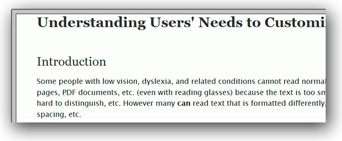
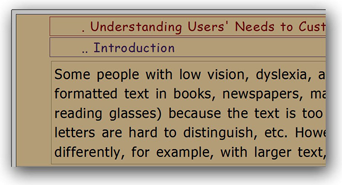
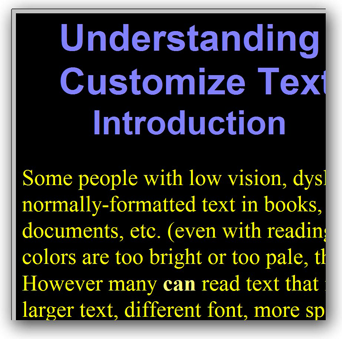
Examples of text customized
Text Customization for Readability
Overview
Millions of people cannot read normally-formatted text, and millions more will not be able to in the coming years as their vision declines due to ageing. Many people with low vision, dyslexia, and related conditions and situations that impact reading cannot read the text in print books, newspapers, manuals, etc. (even with reading glasses). However they can read text that is formatted differently, for example, with larger letters, different font, more spacing, etc.
Electronic media (websites, PDF files, e-books) offers the opportunity for unprecedented access to information for people with print disabilities because accessibility barriers of print can be overcome through technology. With technology such as word processing software, electronic text can be customized (with larger font, etc.) to be readable by more people with visual perceptual impairments.
However, some mainstream technologies and tools do not provide sufficient text customization functionality to make text readable.
PDF files are of particular concern because:
- PDF files are not sufficiently accessible to many people with low vision, dyslexia, and related conditions and situations that impact reading — because Adobe Reader and other PDF viewers currently lack sufficient text customization functionality. (See PDF support for text customization.)
Even well tagged PDF files that are more accessible to screen reader users
are not accessible to many people with other print disabilities. - Essential information — such as tax instructions, scientific papers, educational material, and medical information — is often provided only as PDF.
- Inaccurate use of "accessible PDF", a harmful misnomer {misnomer – a term that suggests a meaning that is known to be wrong} for "tagged PDF", perpetuates the lack of awareness, even among accessibility specialists, that PDF files are currently not accessible to many people with print disabilities because PDF readers/viewers do not let them make the text sufficiently readable.
Part of the issue is that some accessibility guidelines and standards do not sufficiently address text customization requirements in order for people to be able to read electronic text.
Please learn more about:
- Understanding people's need to be able to customize text in order to read, what happens when text is not displayed well, and personal stories.
- The aspects of text display that users need to be able to customize.
- Support for text customization in tools, technologies, standards, and guidelines.
Research and references are throughout this TAdER website.
You can help!
Anyone:
- If you come across text content that is not accessible: Tell the content owner. See Contacting Organizations about Inaccessible Websites for guidance.
- If you want PDF files to be more accessible: Tell Adobe that it's important that Adobe Reader supports users' needs to customize text.
You can:
- complete Adobe's Accessibility feedback form
- complete Adobe's Feature Request/Bug Report Form — for "Product name" select "Adobe Reader"
- If you read "accessible PDF": Gently explain that PDF files are not sufficiently accessible to many people with print disabilities because PDF readers/viewers do not let them make the text readable, and point them to this web page and information on PDF support for text customization. When people say "accessible PDF", they probably mean "tagged PDF", which is more accessible to screen reader users, but still not to many others.
If you...
- design or develop websites or other electronic text: Make sure it works when users customize text display. (for example, see Resize Text in Easy Checks - A First Review of Web Accessibility)
- decide what technology to use to provide information: Provide the information in a format that is accessible with current "user agents" (browsers and readers). PDF files are not currently accessible to people with low vision, dyslexia, and related conditions and situations that impact reading.
- can influence user agent functionality, e.g, you're a product manager, designer, etc. of a user agent (web browser, PDF viewer, e-book reader): Include support in your product for users to be able to customize aspects of text display.
- develop accessibility policies, standards, or guidelines: Ensure that they include requirements to meet users' needs to customize text for readability.
The TAdER Project
Learn about the TAdER Project.

There needs to be universal design of these settings for all computers around the globe, so that all computers—regardless of where you are—are accessible to people who are visually impaired, dyslexic, older, have neurological issues, etc.
— Survey comment
Note: Not W3C WAI
Please be careful in referencing the information on this tader.info website and e-mails from uiAccess.com as from the individual Shawn, not W3C or WAI. Although Shawn also works part-time for the W3C WAI, these are not W3C WAI publications.
Some information on this website may be included in WAI material published on the W3C website — that you can reference as WAI info.
For more information
Shawn Henry
+1-617-395-7664
projects@uiAccess.com
Date: Updated 8 January 2016. First posted 2012.